Skip to content
The Kids Research Institute Australia logo
Donate

Search

News & Events

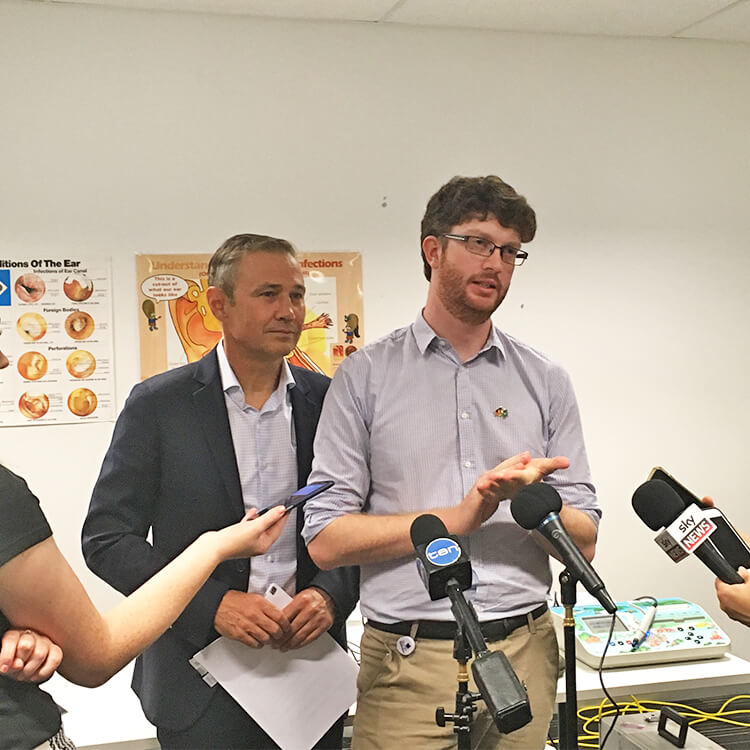
New ear health study music to the ears of Aboriginal children

Wait times for Aboriginal children suffering ear infections could be reduced to less than four weeks thanks to a new The Kids Research Institute Australia research project

Research

Healthy Ears Clinical Trial: A telehealth-facilitated randomised-controlled trial utilising a health promotion intervention to resolve otitis media with effusion for children won specialist Ear, Nose and Throat (ENT) waiting lists

A telehealth-facilitated randomised-controlled trial utilising a health promotion intervention to resolve otitis media with effusion for children won specialist Ear, Nose and Throat (ENT) waiting lists

Research

Evaluating the impact of the ‘Blow, Breathe, Cough’ health promotion intervention in resolving otitis media with effusion in children: An adaptive randomized-controlled trial protocol

Otitis media with effusion (OME) affects hearing, speech development, and quality of life (QoL) in children. The 'Blow, Breathe, Cough' (BBC) intervention promotes nasal, respiratory, and middle ear clearance through nose blowing, deep breathing, coughing, and hand hygiene. It shows promise in resolving OME but lacks randomized-controlled trial (RCT) evaluation. This paper presents a RCT protocol evaluating BBC's effect on OME resolution, hearing, speech, and QoL in children aged two to seven years.

Research

The Investigation of Health-Related Topics on TikTok: A Descriptive Study Protocol

The social media application TikTok allows users to view and upload short-form videos. Recent evidence suggests it has significant potential for both industry and health promoters to influence public health behaviours. This protocol describes a standardised, replicable process for investigations that can be tailored to various areas of research interest, allowing comparison of content and features across public health topics.

Research

Raine Study - Senses Special Interest Group

Chris Andrew Monique Sarra Videos Brennan-Jones Whitehouse Watch and listen to Andrew Robinson Jamieson PhD PhD PhD MPsych (Clin) MAPS BSc (Hons) MSc

Research

Engaging longitudinal cohort participants in a research priority setting process for the Raine Study

The Raine Study is a long-running study looking at the health and well-being of a group of Western Australian families for over 35 years. Participants are at the heart of the study, shaping its research direction and communication. While participants have previously contributed to research grant development, they had not been directly involved in setting the Raine Study’s overall research agenda.

Research

“We've wanted to vaccinate against it and now we can”: views of respiratory syncytial virus disease and immunisation held by caregivers of Aboriginal children in Perth, Western Australia

Respiratory syncytial virus (RSV) is a major cause of respiratory infection with a higher burden in Aboriginal and Torres Strait Islander infants and children. We conducted a pilot qualitative study identifying disease knowledge and willingness to immunise following the changing immunisation landscape for infant RSV in 2024.

Research

Development, construct validity and utility of a cross-culturally adapted Otitis Media-6 (OM-6) questionnaire for urban Aboriginal and/or Torres Strait Islander children

Tamara Chris Valerie Veselinovic Brennan-Jones Swift BSc(Hons) MClinAud PhD PhD Clinical Research Fellow Head, Ear and Hearing Health Aboriginal

Research

Cohort profile: The WAACHS Linked Data Study

Despite the volume of accumulating knowledge from prospective Aboriginal cohort studies, longitudinal data describing developmental trajectories in health and well-being is limited.

Research

The use of tranexamic acid in paediatric adenotonsillectomy – A systematic review and meta-analysis

Tonsillectomy and adenoidectomy are two of the most commonly performed ENT procedures in children, with over 500,000 cases performed annually in the United States. Whilst generally considered a safe and well-tolerated operation, it is not without its risks and complications including pain, nausea, anorexia and most importantly bleeding and post-tonsillectomy haemorrhage.